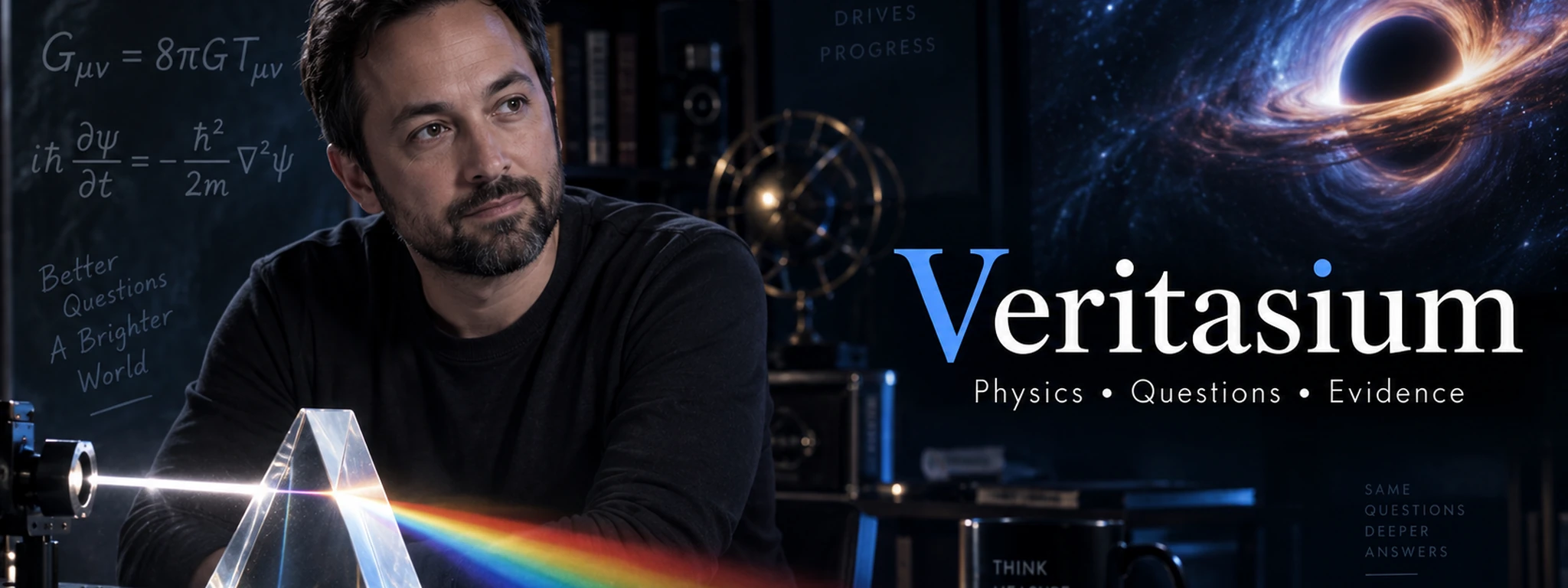
Veritasium
Veritasium focuses on physics, science questions, experiments, misconceptions, and counterintuitive explanations.
Score
Why Veritasium stands out
Our editorial assessment of the channel’s strengths, trade-offs, and the type of viewer who will get the most from it.
Veritasium is built around the uncomfortable moment when an intuitive answer turns out to be incomplete. Derek Muller uses misconceptions, paradoxes, experiments and interviews to expose the gap between what feels obvious and what the evidence actually supports, making the channel especially strong for viewers who enjoy thinking through a problem before being given the explanation.
Questions before answers
A typical Veritasium episode does not begin by listing facts. It begins with a question that seems simple enough to answer quickly. Muller then tests the first intuition against an experiment, a historical case, a mathematical argument or expert testimony. That structure keeps the viewer cognitively involved instead of turning the video into passive explanation.
The approach is especially effective in physics because so many everyday intuitions break down at unusual scales, speeds or boundary conditions. The channel makes that friction part of the story.
Depth without becoming a lecture
Veritasium often covers topics that could easily become abstract — electricity, probability, information, relativity, materials, mathematics — and finds a visual or historical route into them. Good episodes move between demonstration and theory, giving the audience enough conceptual scaffolding to follow the key result.
The channel also makes productive use of disagreement. Competing explanations or unresolved questions are not always edited away, which helps viewers see science as a process rather than a finished list of truths.
Why it rewards repeat viewing
Some Veritasium videos are dense enough that a second viewing reveals more than the first. That is a positive characteristic for viewers who want more than lightweight science trivia. The channel is good at leaving a memorable conceptual puzzle that continues to make sense after the video ends.
It is therefore a strong choice for advanced high-school students, university learners, teachers and adults who want rigorous popular science without committing to a full formal course.
Where caution helps
The hook-driven structure can occasionally make a controversy or paradox feel sharper than the underlying specialist debate. Complex subjects are necessarily compressed, and viewers should be careful not to treat one elegant explanation as the entire field.
When an episode touches active research or contentious interpretation, following the cited sources and expert material is worthwhile. Veritasium is often an excellent starting point, not the final word.
A good Veritasium episode can make a viewer suspicious of any problem that looks too easy, which is often a useful scientific habit.
Watch Veritasium if you…
- you enjoy counterintuitive physics and scientific puzzles
- you like explanations that challenge your first intuition
- you want more depth than science trivia
- you appreciate experiments, history and expert interviews together
Probably not your first choice if you…
- you want a linear beginner course
- you dislike unanswered or contested questions
- you need primary-source depth on every topic
Tube7X Verdict
Veritasium is one of Tube7X's strongest science recommendations for viewers who want intellectual friction rather than simple fact delivery. Its combination of experiment, history, mathematics and misconception-driven storytelling can make difficult ideas memorable without pretending they are easy. The channel works best when used as a launch point for deeper reading, but as a discovery tool it is exceptionally strong.
Veritasium is recommended for viewers whose interests match the channel’s specific strengths, with the trade-offs above kept in view.