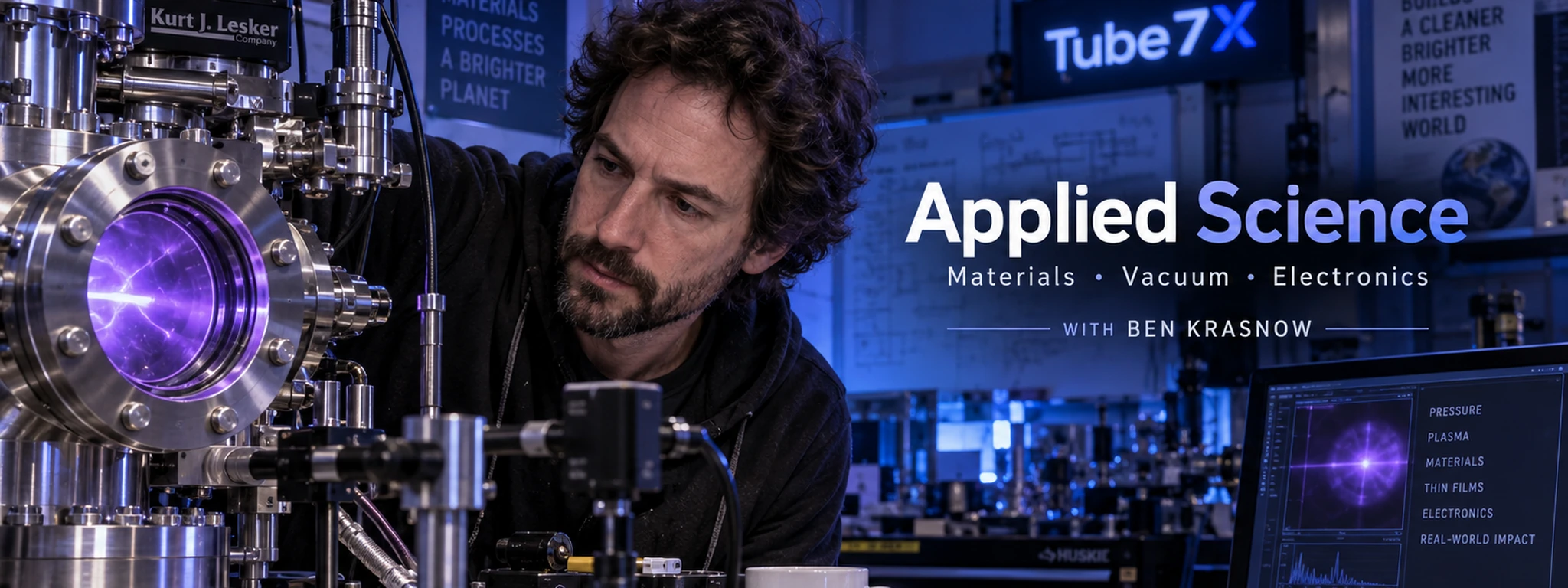
Applied Science
Applied Science focuses on hands-on experimental science, electronics, fabrication, and laboratory-style projects.
Score
Why Applied Science stands out
Our editorial assessment of the channel’s strengths, trade-offs, and the type of viewer who will get the most from it.
Applied Science is a workshop-and-laboratory channel for viewers who want to see sophisticated technical processes carried out at bench scale. Ben Krasnow moves comfortably across vacuum systems, electronics, optics, materials, chemistry and instrumentation, often building or adapting the equipment needed to investigate the problem himself.
A real experimental-workbench feel
The channel is less polished than mainstream science entertainment in exactly the right way. Cameras stay on fixtures, chambers, meters and samples long enough for the viewer to understand what is physically happening. Krasnow explains decisions as part of the process, including why a material, sensor or geometry is appropriate.
For technically experienced viewers, that practical density is the main attraction.
Cross-disciplinary engineering
Applied Science is difficult to place in a single box because many projects combine several fields. A vacuum experiment may require machining, electronics, materials knowledge and measurement technique; an optical project may turn into a problem in fabrication or control systems. The channel shows how real engineering often crosses textbook boundaries.
That makes it especially useful for makers and engineers who are comfortable learning just enough of a neighboring discipline to solve a concrete problem.
Who should watch
Advanced hobbyists, engineering students, laboratory professionals and technically curious adults will get the most from the channel. Viewers who already know basic electronics or laboratory concepts can follow the experimental logic without needing every term defined from first principles.
It is also valuable simply as exposure to instrumentation: seeing how a vacuum chamber, sensor, deposition process or optical setup is actually assembled can make abstract concepts much more concrete.
Accessibility and safety limits
Applied Science can be demanding for beginners. The videos often assume comfort with tools, measurement and physical reasoning, and they may involve vacuum, heat, chemicals, high voltage or specialized hardware.
The channel should therefore be watched as documentation and education, not as permission to reproduce a procedure without equivalent knowledge, equipment and safety controls.
One of the channel's pleasures is watching a complicated laboratory capability emerge from equipment that was never sold as a turnkey system.
Watch Applied Science if you…
- you like laboratory hardware and instrumentation
- you have some technical background
- you enjoy vacuum, optics, electronics and materials science
- you want to see experiments built rather than merely described
Probably not your first choice if you…
- you need beginner-level definitions for every concept
- you want entertainment-first pacing
- you may copy hazardous procedures without suitable controls
Tube7X Verdict
Applied Science is a specialist recommendation, but a very strong one. It offers unusually concrete access to experimental engineering and laboratory practice, with enough explanation to show why each setup works. The learning curve is higher than most channels in this category, yet that technical density is exactly what makes it valuable.
Applied Science is recommended for viewers whose interests match the channel’s specific strengths, with the trade-offs above kept in view.